
- Published on
From Keywords to Meanings- Developing a Semantic Search Engine for Ecommerce Websites
Introduction
Ecommerce has become the default marketplace for millions of people worldwide. With such an overwhelming number of products available, the biggest challenge for both customers and retailers is search. Traditional keyword-based search engines are often too literal, producing noisy results that frustrate users and cost businesses sales.
Semantic search addresses this gap by going beyond simple keyword matching. Instead of treating search as text string matching, it interprets meaning and intent. In this article, we’ll explore how we built a semantic search engine tailored for ecommerce websites using OpenAI embeddings and the Pinecone vector database. We’ll cover the technical implementation, business impact, and revenue opportunities for deploying such a system.
Why Keyword-Based Search Falls Short
Conventional keyword search works by matching query terms against product descriptions. While simple, this approach struggles with:
- Synonyms: “Sneakers” vs. “trainers”
- Context: “Apple charger” vs. “apple fruit”
- Ambiguity: “Black dress” could mean color, style, or brand
This often leads to irrelevant results, leaving users frustrated and less likely to convert.
Semantic search solves these problems by using Natural Language Processing (NLP) to infer intent. Rather than only finding textual overlaps, it interprets the query’s meaning and retrieves products aligned with the user’s intent.
Semantic Search in Action
Imagine a shopper searching for:
“Comfortable running shoes for flat feet.”
- A keyword search might return all items containing “running” and “shoes.”
- A semantic search engine, however, recognizes the context (“comfort,” “flat feet”) and prioritizes orthopedically designed sneakers.
This higher relevance translates directly into better user experience, higher engagement, and improved sales conversion rates.
How We Built It: OpenAI + Pinecone
Our solution combines two key technologies:
1. OpenAI Embeddings
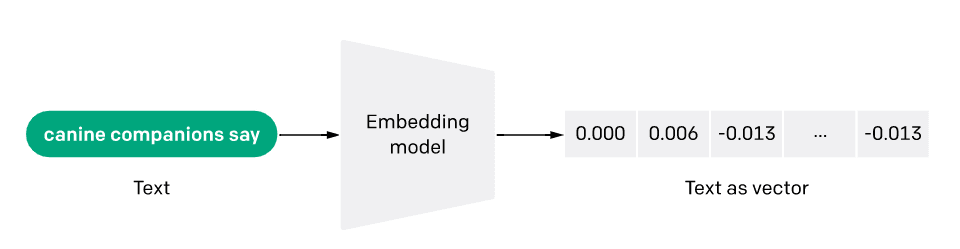 source: openai.com For example:
- “Red leather handbag” and “Crimson purse made of leather” generate vectors positioned near one another in vector space.
We used OpenAI’s API to generate embeddings for every product in our catalog.
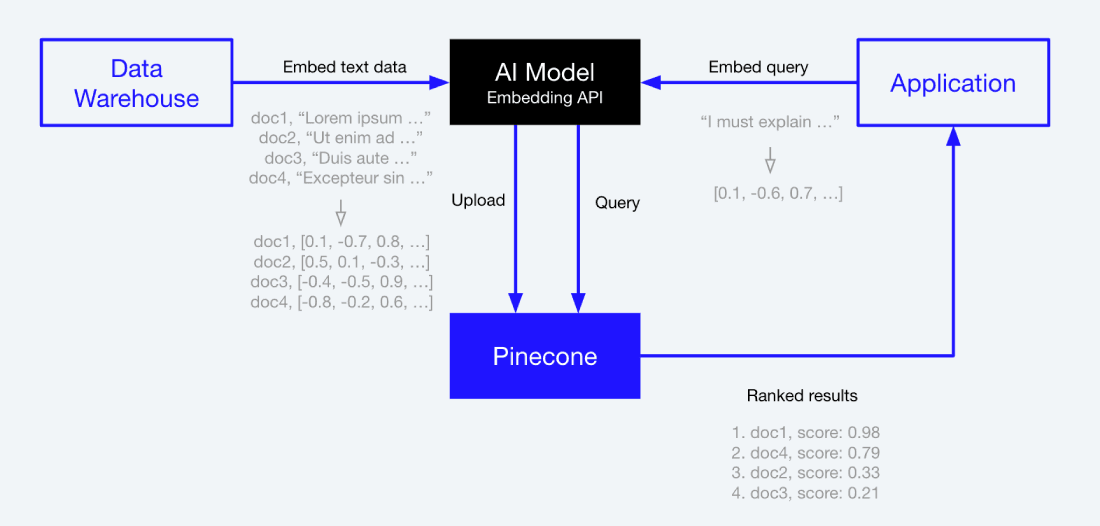
2. Pinecone Vector Database
 source: pinecone.io
Our pipeline looks like this:
- Scrape product data (title, description, images, brand, URL).
- Convert descriptions into embeddings using OpenAI.
- Store embeddings in Pinecone for similarity search.
- When a user searches, embed the query and retrieve the closest product vectors.
This results in a ranking of products most semantically aligned with the user’s intent.
Business Value & Monetization
Beyond technical improvements, semantic search unlocks tangible business benefits:
- Increased conversion rates: Customers find what they need faster.
- Reduced bounce rates: More relevant results keep users engaged.
- Personalization: Embeddings can be extended with user profiles for tailored recommendations.
- Cross-selling opportunities: Related products surface naturally due to semantic proximity.
Revenue Opportunities
- Subscription model: Charge ecommerce sites a monthly fee based on product catalog size.
- Advertising: Enable promoted listings alongside relevant queries.
- Analytics services: Sell insights into user intent, demand patterns, and missed opportunities.
- Partnerships: Integrate with ecommerce platforms (e.g., Shopify, Magento) as a plugin or API.
Conclusion
Semantic search represents the future of product discovery in ecommerce. By combining OpenAI embeddings with Pinecone’s vector search capabilities, businesses can deliver search results that reflect meaning, not just keywords.
For ecommerce websites, this translates to happier customers, stronger loyalty, and higher revenues. For developers and entrepreneurs, it represents an opportunity to build scalable solutions that sit at the intersection of AI, retail, and user experience innovation.